
Conventional banks are, at their core, financial intermediaries built on interest. You deposit your cash, the bank pays you a little interest on it, and it then lends that capital out to others at a higher rate. The profit is the spread between the two.
So the natural question is this: what does a bank that follows Islamic principles, and prohibits interest in both directions actually do to earn a profit? What function does it serve in an economy, and does that function match a conventional bank’s?
This article explains the role of an Islamic bank, the mechanisms that underpin how they operate, and their wider purpose within markets. It also covers the main products and providers, and what all of this means for you in practice as a consumer.
Let’s start from the deposit side.
Deposits: how Islamic banks are funded
A retail bank (what we colloquially refer to as a bank) and similarly an Islamic bank, primarily raises funding via customer deposits. The are two ways this is done;
The first is the current account. This is structured as an interest-free loan: you deposit your money and, in effect, lend it to the bank for no return. You are simply using the bank to safeguard your money and to give yourself a centralised place for income and expenses to flow in and out of.
You can get this at a conventional bank too, you just ask for a zero-interest current account. The advantage of choosing an Islamic bank however is that it is far more likely to put that loaned capital towards ventures aligned with Islamic principles. The most obvious example is that it won’t be lending your money out at interest. And where a bank does touch any non-Shariah-compliant activity, it will at least segregate those funds so they don’t mingle with the rest.
A current account is useful for the reasons above, but I wouldn’t personally recommend it for long-term savings. Inflation eats into your purchasing power, so money sitting in a zero-return account loses real value over time.
The second source of funding is the savings account, which does generate a return. If not interest, then what?
Here the relationship looks more like an investment than a deposit. The bank and the saver form a profit-sharing partnership known as Mudaraba, where the depositor acts as an investor rather than a lender, and the bank acts as the fund manager, contributing expertise and the infrastructure, rather than capital. The bank finds investment opportunities (or, under a two-tier structure, appoints third parties to do so on its behalf) that are tied to real economic activity and assets. It pools the money from savers, invests it, and shares the resulting profit with them at an agreed split. This behaves far more like equity than debt: both sides are entitled to a pre-agreed share of whatever profit is generated.
That makes it materially different from a conventional savings account. Because the deposited funds carry the same risk and volatility as any other investment, if the venture doesn’t work out, some of the original capital can be lost. This follows a principle covered in earlier articles: no profit without liability. A conventional bank argues that because it manages liquidity and credit risk, it has earned its return, but under Shariah principles that reasoning doesn’t hold, because it amounts to a pure return on money rather than on any real asset.
In practice, though, this looks different once you factor in the regulatory landscape. In the UK, for example, most of the Islamic banks available to retail savers are covered by the Financial Services Compensation Scheme (FSCS), which protects up to £120,000 per person, per authorised firm (as of time of writing: July 2026). So depositors’ initial capital is automatically protected up to that limit. These banks also quote an Expected Profit Rate (EPR) that tracks prevailing market rates, much like an advertised savings rate. The EPR however is not guaranteed and can change, (the bank will notify you if it does), and the profit itself is still generated from investment in real economic activity, and banks monitor those investments closely to keep returns steady.
So while the practical version is a somewhat smoothed-out take on the theoretical model, it still generates non-interest, investment-based returns. Many scholars accept this slightly compromised application, seeing it as shaped by the regulatory landscape rather than as a breach of principle.
Now that the bank has funds to work with, how does it actually put them to use?
Islamic bank financing: deployment of capital
There are several ways an Islamic bank can use depositors’ funds to generate a return for both the bank and its savers, and many of them sit adjacent to how a conventional bank earns interest. The key difference is that the Islamic bank invests in genuine business ventures , or becomes a direct participant itself, rather than simply lending cash.
Home financing: The bank uses depositors’ funds for property finance, most commonly through the Diminishing Musharaka model. Here the bank and the buyer enter a joint venture to purchase a property together. The bank earns rent on the share it still owns, and that share along with the rent, shrinks over time as the buyer gradually buys the bank out through capital repayments.
You can read a more in-depth explanation of Islamic home financing in my earlier article here: What are Islamic mortgages and how do they work?
Deferred contracts of exchange: These are the instruments Islamic banks tend to favour, because their returns are more predictable, they behave a lot like the fixed-income instruments used in conventional finance, and they often relate to business and trade finance. The main ones are explored below.
Murabaha (cost-plus sale)
I touched on this in the mortgages article, but it applies just as readily to other asset classes. The asset is sold at a pre-agreed markup, paid for at a deferred date (though it can also be at spot), with full transparency on both the underlying cost and the markup applied. It can function like a business loan: a company wants to buy an asset to trade, say, a commodity of some kind, but doesn’t have the cash to acquire it upfront.
The crucial difference is that the bank actually procures the asset (in practice it usually appoints a third party, or the buyer themselves, to do so on its behalf), takes ownership of it, and then sells it on. Its profit is the markup. In a conventional loan, by contrast, the bank has no real tie to the underlying asset and no exposure to its specific risks; instead it takes personal assets as collateral and charges interest on the amount borrowed.
To protect itself against losses in a Murabaha, the bank can require a non-refundable deposit towards the purchase, or build in a grace period so it can cancel the contract if the buyer doesn’t complete.
Ijara (lease)
Also touched on in the mortgages article. Here the bank acts as a lessor: it takes ownership of an asset, manufacturing machinery, say, or a car, and leases it out to the client. A sale-and-leaseback is also permitted, where the client sells an asset to the bank and then leases it straight back. Most of these arrangements end with ownership transferring to the lessee at the end of the term, since the bank usually has no reason to hold on to the asset.
Salam (forward purchase)
A Salam contract is essentially a short-term provision of funds, often used for working-capital finance. The bank pays in advance for an asset that might not yet exist, or is not immediately available, and the client commits to producing (or sourcing) that asset at an agreed point in the future.
The bank profits without ever wanting to hold the asset, by entering a parallel Salam contract, two simultaneous Salam contracts occur but with different parties. It immediately lines up another party (the ultimate buyer of the goods) in a matching Salam contract, agreeing to deliver the goods to them once the original client produces them.
The bank sits on the opposite side of that second contract (essentially being the one who promises procurement or production of the goods but this is generated from the first contract) and can charge a higher price than it paid the original client. (That markup is typically pegged to a market reference rate (e.g. LIBOR/SONIA rates)
You might wonder why the ultimate buyer doesn’t just deal with the original client directly and cut out the middleman, since it would be cheaper. The answer is a number of reasons but mostly trust: the bank is a more reputable and reliable counterparty than an individual producer, and the final buyer would rather the bank carry the delivery risk.
Istisn’a (project finance)
Istisn’a is a variant of Salam used for project financing. If a large asset needs to be built , heavy machinery for a manufacturing plant, for instance, the buyer can use Istisn’a to finance its construction with the bank’s help. The bank contracts directly with the manufacturer to build the asset, and appoints the buyer as its agent to handle the arrangement on its behalf. Payment is usually made in instalments tied to construction milestones.
As with Salam contracts, the bank’s exit is a parallel Istisn’a contract, and its profit is the margin between the two: one contract with the manufacturer to build the asset, and a simultaneous one, at a markup, with the final buyer who actually wants it.
Sukuk
The last major route for deploying depositors’ funds is the Sukuk. It is often described as the Islamic analogue of a conventional debt security like a bond, because it produces a predictable stream of income until maturity, at which point the capital is returned. But Sukuk is not debt: each one represents a share of ownership in an underlying asset, so the income is tied to how that asset performs and isn’t strictly fixed.
Sukuk is a broad topic in its own right and I’ll cover it properly in a later article, but it’s worth flagging here because banks commonly issue them to fund investments across assets, projects, and business ventures.
To sum up: every deployment of capital is tied to a real asset or genuine economic activity, with the bank taking on some form of ownership or risk rather than simply lending money at interest. The bank acts as a facilitator and intermediary of economic activity, but in a way that is more equitable and doesn’t build the kind of overbearing, compounding debt that conventional lending can.
Islamic in form and in substance
We’ve covered how an Islamic bank funds and deploys capital. But there’s an important question underneath all of it: what ensures a bank as genuinely Islamic, rather than just being branded that way?
The main safeguard is the Shariah Supervisory Board (SSB), which is built into the governance of these institutions (and often also conventional banks offering Islamic products).
An SSB is an independent body responsible for ensuring that operations, products, and transactions are all Shariah-compliant. It reports and acts on behalf of shareholders, and its members are embedded across a firm’s functions and throughout the lifecycle of each relevant product. They are typically learned scholars with deep knowledge of Islamic jurisprudence alongside economics, finance, and law, and they maintain ongoing compliance through periodic reporting, certification, and internal Shariah audits.
The point of all this is to ensure that a bank’s Islamic framing isn’t just marketing, but a genuine signal of legitimacy to the people who need these products. That said, governance quality varies between institutions, and there is real debate over whether some approved structures honour the spirit of the principles or merely the letter.
As things stand, several common practices are far from perfect. One of the most debated is Tawarruq. This is where a party buys a good on deferred terms and then immediately sells it on to a third party to raise cash. A common version appears in commodity markets as the commodity Murabaha: a commodity is sold at a markup on deferred terms, and the buyer immediately sells it on at spot price.
Neither the bank nor the buyer actually wants to own the commodity, so the whole thing functions as a roundabout way of replicating short-term liquidity financing, or from a retail perspective, a personal loan.
A minority of schools of thought forbid transactions like this outright. The majority permit them, but only under conditions, for instance, a clear separation between the purchase and the sale, with no contingencies linking the two.
There is also a practical argument for structures like this, because taxes such as VAT and capital gains tax can create real obstacles for Islamic finance instruments. Since these structures involve buying and then reselling the same asset, they can trigger tax twice over, where a conventional loan, which involves no asset, would not. A commodity Murabaha, however, avoids the worst of this: by using wholesale-market commodities such as metals as the vehicle, you can structure the cash-raising transaction while sidestepping the VAT stacking that would hit if you were buying and reselling ordinary VAT-able goods, thanks to the VAT reliefs that apply to such trades.
As these institutions grow and expand into wider markets, the pressure on boards and standards is likely to push them towards more consistent, more practical outcomes, and Islamic financial institutions, working with their SSBs, are already taking active steps to find better alternatives.
What does this all mean for you - the practical recommendation
We’ve spent most of this article on the financing side, but I appreciate that most people reading aren’t looking to engage in business finance. They’re curious about the depositing side, and what they can actually do with their money.
As covered above, a savings account is a straightforward way to earn a passive return , less than you might make investing in equities, but still more secure. You open the account, let the money sit, and it earns a return, with your capital protected up to the FSCS limit. There’s a decent range of products on the market, including easy-access savers and fixed-term accounts.
Some of the current (Jul 2026) products on the market and their corresponding lowest and highest annual rate products are listed below;
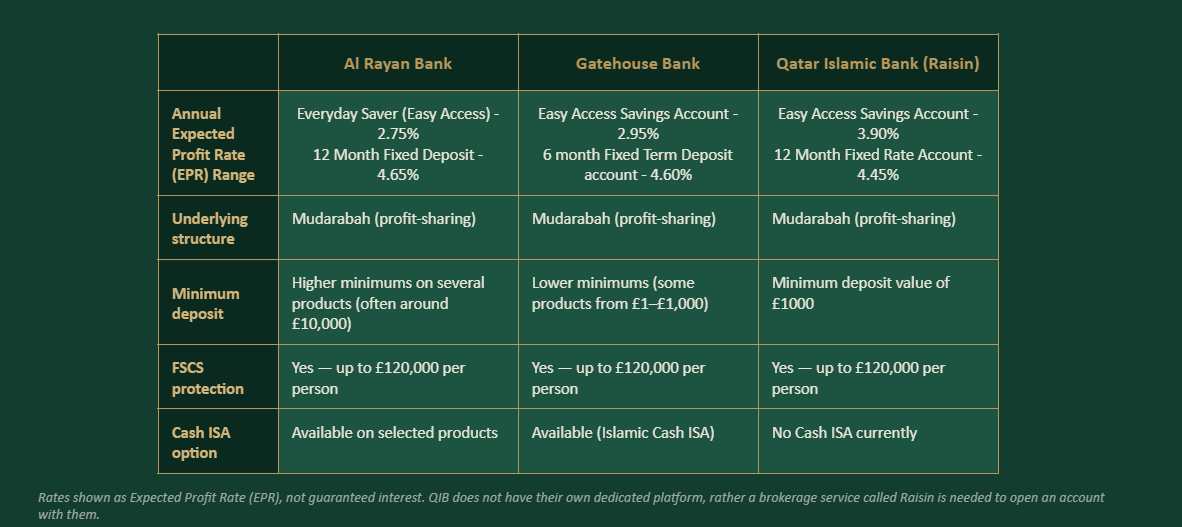
The number of providers are fairly scarce currently, but competition has been improving, and that has been reflected in the rates provided. There is also the option to mix and match products and providers as say QIB has the best easy access rates currently, but Al Rayan has better long term options. There is also consideration into other factors such as minimum deposit amounts, customer service , ease of setup, app UI etc, with Gatehouse being cited as the easiest to access as they have easy setup, low initial deposit accounts.
Personally from my experience, I have noted Al Rayan to be the most administratively heavy to set up, Gatehouse to be fairly easy to setup, but the simplest has been setting up QIB account via Raisin. It required no paperwork, and could be done all online via the Raisin app/website. The drawback however is that you are having to do via a brokerage service so you are not directly dealing with the bank. This might cause lag in the complaints and queries process, but I have not noted any such issue myself yet.
These rates are also genuinely competitive with interest rates that UK banks currently offer. Here is a list of some of the current conventional comparative bank offerings:
Santander - 4.30% Fixed Rate & Term Deposit ISAs / 2.00% Easy Access Cash ISAs / 8.00% Regular savings accounts (this includes a joining bonus of 5.00% for first 12 months, but actual rate is 3.00%
HSBC - 4.00% Fixed Rate ISAs / 3.35% Easy Access Rate (up to £50,000)
Barclays - 1.00% Everyday Saver / 3.80% 1 Yr Fixed Rate Bond
Here we can see the Shariah compliant products are in line with and in many cases yielding higher returns than the conventional counterparts, despite these large banks benefiting from economies of scale. This gives reason for even non-Muslim savers to look into switching savings accounts to one of these Islamic Banks.
It highlights a wider point: on the surface, the product can look economically similar, but underneath it is fundamentally a different one. It’s a product that not only spares Muslims the feeling of having to compromise on their values, but that also stands up competitively on its own terms.
Closing
In upcoming articles I’ll revisit what the current landscape looks like, since macroeconomic variables like interest and inflation feed directly into these products and have moved in unexpected ways in recent years. I’ll also dig further into Sukuk, another avenue banks use to deploy capital. Stay tuned.
If you are thinking of switching or opening an Islamic Savings account, please make sure to look at current rates and account structures before you do. Also please read reviews from other users of the platforms to better gauge the user interface, and what would best suit your needs.
Thanks for reading,
Aqila Finance.