

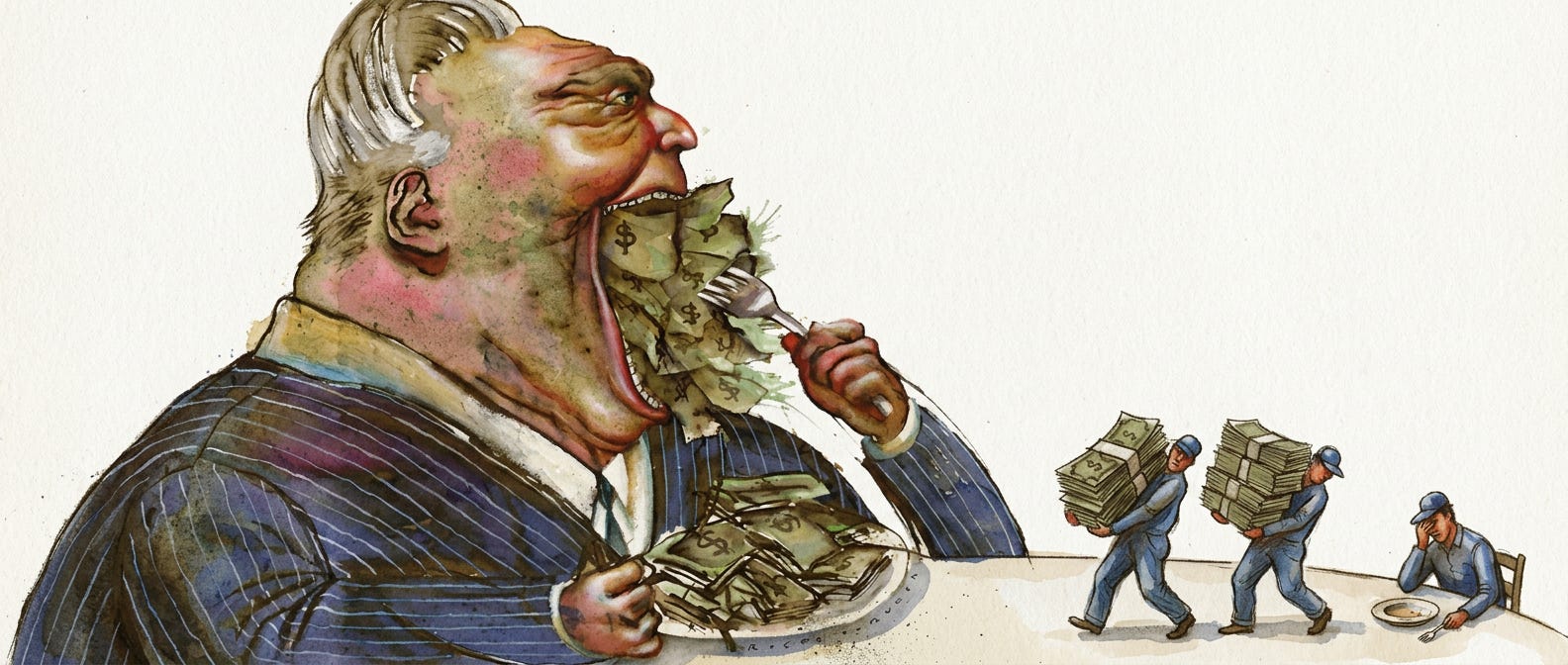
You’ve heard it countless times.
The drastic wealth inequality gap statistics: the richest 10% own 75% of global personal wealth, whilst the bottom 50% own 2%. Or the exorbitant CEO pay ratios where the average US executives of large listed firms, earn over 300 times that of their typical employee.
This reality of ubiquitous greed and hoarding of wealth is a result of a distorted capitalist system that doesn’t provide sufficient guardrails to mitigate these outcomes, but rather, incentivises the underlying behaviours.
Capitalism itself is not the root cause. Rather, when insufficient controls exist and accountability and distribution frameworks are lacking, negative socio-economic outcomes can arise. In such a system, wealth and status become worshipped, and market participants come to see it necessary to accrue as much as possible, sometimes regardless of the costs.
Instead, a system that is predicated on money being a means for development, growth and social progression, rather than the goal itself, is, in my belief, more beneficial to all involved.
One avenue to achieve this is through the lens of religion. Namely Islam and by extension Islamic finance. I don’t believe this to be a better system simply because it is Islamic. Rather I believe that a theological framework builds in stringent moral guidelines that acts to prevent said negative outcomes. Secular groups echo the same failings, and have incorporated gestures to try and alleviate this (e.g. ESG initiatives and regulation, B-corps etc.). Islamic finance however never severed finance from ethics. These issues are far more deep-rooted and this unbroken link acts as a significant advantage.
Its not Islamic Finance vs Capitalism
Islam does not inherently view capitalism as bad. Islam is emphatically not anti-wealth, anti-free markets or anti-trade. Conversely, the prophet Muhammad (p.b.u.h), the individual whom Muslims regard as the exemplar for how to conduct themselves, was a merchant who advocated for trade, protection of private property and legitimate profit.
Where Islam and modern capitalism diverge is the allowance for the extreme avarice and the limitless consumerism that treats acquisition as an end in itself. Modern capitalism does not seek to answer “how much is enough?”. Rather, it has recast this absence of limit as a virtue. Corporate entities pursue a perpetual growth imperative and treat the maximisation of shareholder value as fiduciary duty. Islam’s contribution here is that it embeds these limitations within its core framework, and implements the structures and the instruments to act on them.
This is important as the root cause of the overaccumulation of wealth and excessive spending on luxury goods, is more systemic than individual. Every tradition condemns the greedy individual, this is not unique to Islam. Where greed can be spread is when the socio-economic structure allows for it.
Conventional finance does not simply tolerate the greedy individual, it encodes acquisition into its mechanisms. Interest for example, often guarantees returns without appropriate contribution or risk. Limited liability legal structures, combined with shareholder primacy, makes maximisation the de facto benchmark to be judged against. An economic system so dependent on debt makes perpetual growth compulsory, simply to keep pace with the exponential debt increases that interest causes, decoupling gains from economic activity.
Islamic finance therefore responds in kind to these issues directly. Its remediation is structural. It does not only encourage the individual to not be greedy from a moral perspective, it changes the rules to prevent avarice from arising in the first place.
What does Islamic Finance do differently?

There are a number of structural differences, Islam and Islamic finance implements to help prevent avarice, both at the micro and macro levels. These are explored below;
Rejection of Consequentialism - In Islam intention (niyyah) is constitutive of an act’s moral worth and not just incidental to it (actions are judged by intentions, and even having the intention alone can accrue good deeds). You therefore cannot launder a corrupt motive through a good outcome. The ends cannot justify the means, as the consequentialist view would take. Where this differs from the conventional , more secular view, is that capitalism is allowed to run free as long as it has a positive outcome. There is no stopping rule defined on wealth generation and accumulation , as the outcome of economic development and growth, justifies it. In the context of modern capitalism, maximizing shareholder value has become a fiduciary duty, regardless of whether it is obtained via immoral means.
Theological Reframe - Islam views wealth in a entirely different lens. The underpinning theme being Amanah, the sacred responsibility. Here wealth is seen to ultimately belong to God. Everything he has created is in his domain, and thus the individual is seen as trustee of wealth, not its sovereign owner. This reframes the entire relationship with wealth, status and the associated self-worth. Wealth is not meant to be worshipped. It is a means to worship. It is to be used for the sustenance of oneself and their family but also the wider community.
Prohibition of Riba (Usury) - A topic covered in numerous previous articles. Exclusion of interest within financial markets severs the guarantee of gain without appropriate risk or contribution. Creditors are able to exploit the compounding of interest to exponentially accumulate money. This structural intervention forces capital to participate rather than to extract. It prevents debt accumulation from decoupling and rapidly outpacing productive growth.
Risk Sharing - Relatedly, the requirement of risk sharing in Islamic finance embeds skin in the game as a moral principle. It re-couples reward to risk and real economic activity.
Asset Backing - Islamic finance requires financial instruments and transactions to be backed by real assets. It tethers finance to the real economy and prevents the paper-wealth inflation that fuels economic bubbles.
Zakat (Charitable Giving) - The institutional answer to hoarding of wealth is given by enforcing an obligatory annual levy fo 2.5% above a threshold amount (value equivalent toa specified amount of gold or silver). Not only does this wealth get collected specifically for philanthropic purposes, it also penalises sitting on capital and incentivises circulation. This is as although it falls on circulating and liquid wealth (cash, gold, receivables and trade goods), and the income generated by productive assets, it does not fall on the value of the productive asset itself (business premises, machinery, tools of trade etc), or any personal assets such as a home or car. Idle cash therefore slowly haemorrhages against the levy, whereas employed capital can out earn the levy.
The Higher Purpose of Shariah (Islamic Law) - The Shariah encourages wealth generation and protection. It however ties to this a greater purpose. That purpose being wealth as a means of good. It should serve the flourishing of humankind, not merely accumulated as a status symbol. Islamic belief is deeply intertwined with the existence of an afterlife which is determined by the scale of deeds. Excessive amounts of wealth mean nothing in this context , the importance therefore pivots to using said wealth for a greater purpose, to attain good deeds.
The honest reckoning - Does Islam practically solve for capitalistic greed?
I have only spoken from a perspective of Islamic principles but have not posed the question of whether this outcome is achieved when practically applied. The natural instinct is to look at Muslim-majority countries and see whether they suffer the same issues. Unfortunately, many of them such as in the Gulf region, they do, with wealth prominently tied to status. Many Islamic scholars would however say that these countries have strayed away from their Islamic roots in this respect. This same is somewhat true for Islamic finance.
If you have read any of the previous articles, you’ll know I critically assess all facets of Islamic finance. It has certainly not solved for avarice. It has come a long way but it has much further to go. That is precisely why I still write about it and champion it as an alternative option to the conventional system. The principles contain resources the conventional system structurally lacks, and that’s why it is worth considering for those who choose to follow the faith and those that do not.
The tragedy is that the industry has barely yet to draw on them. But it is taking steps in the right direction. Products like Islamic mortgages are mainly equity-based rather than debt-based structures and invoke the risk-sharing principle (see more on this here: Aqila Finance).
These things do take time and the trajectory seems positive. The religion itself took approximately 13 years (its early Meccan period) to institutionalise and for the defining tenants that distinguish the religion, to take place.
Whether avarice would cease to exist as Islamic finance prospers, is admittedly unlikely. But I do believe that in a system that is predominantly hinged on these principles, the problem would be far less prevalent. Hopefully that day comes sooner rather than later.
Thanks for reading,
Aqila Finance